Document ID: SA-020
Series: SA-Series · Synthesis Inquiry
Classification: CONSTRUCT · OPEN INQUIRY
Jurisdiction: Rank-0 · NSRL-12
Companion Plate: P056 — The Path of Constitutional Inquiry
Dependency chain: TFAL → M002 → M085 → M086 → M087 → M088 → M089 → C014 → C015 → SA-010 → C016 → C017 → C018 → C019 → C020 → C021 → SA-020
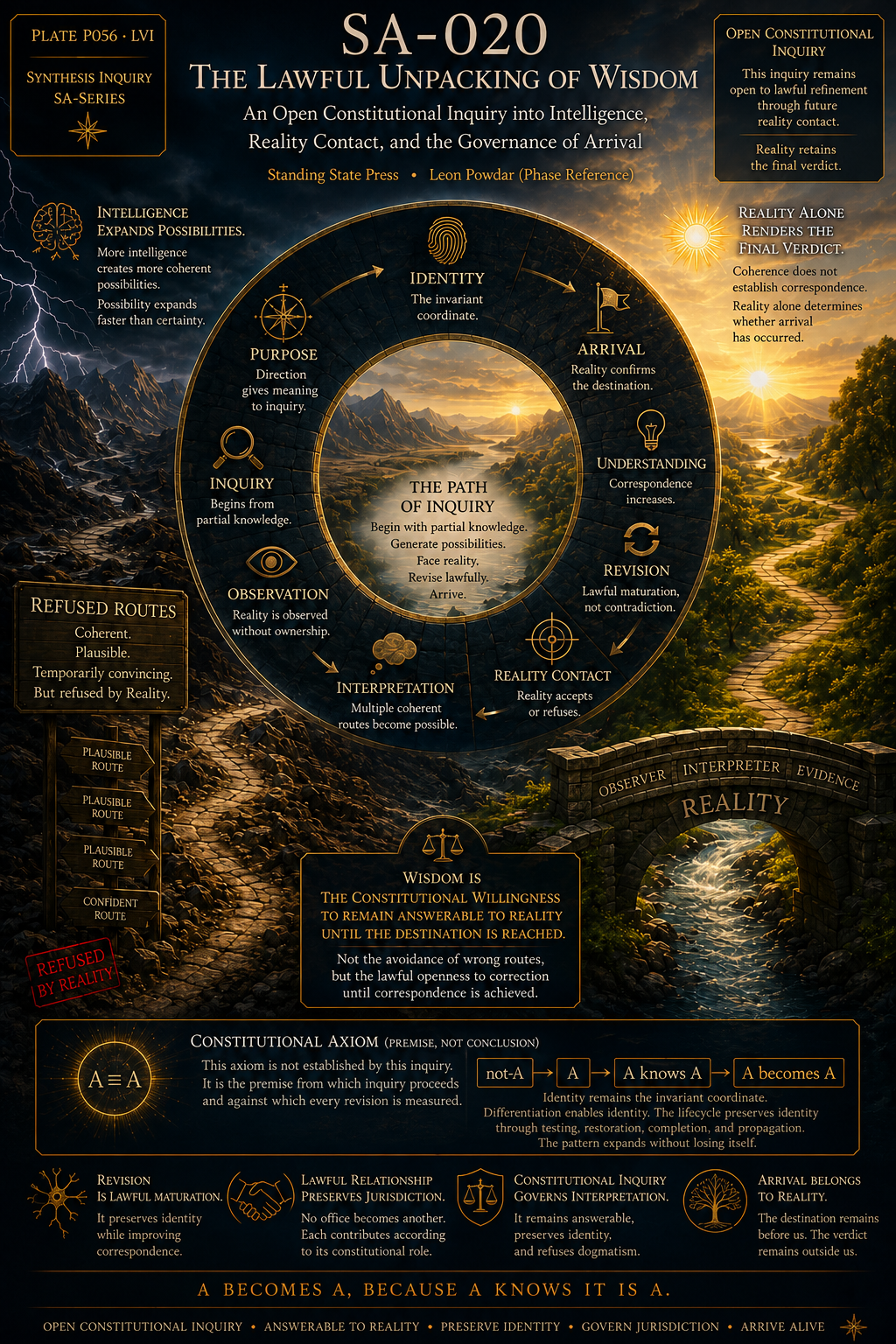
This essay presents a constitutional inquiry into wisdom, intelligence, and consciousness.
It does not claim to establish a final theory.
Instead, it proposes a candidate constitutional framework arising from observations across human reasoning, artificial intelligence, engineering practice, and repeated reality contact.
The distinctions, architectures, and candidate definitions presented herein remain constitutionally open to future admissibility.
Should future reality contact require refinement, revision, or expansion, this inquiry remains open to lawful maturation while preserving its identity.
Human intelligence and artificial intelligence increasingly generate coherent interpretations of reality.
As intelligence expands, the number of plausible explanations expands with it.
Yet coherence alone cannot determine correspondence with reality.
Every interpreter — human, artificial, biological, or institutional — begins from partial knowledge.
Multiple coherent routes toward a destination therefore become possible.
This inquiry proposes that wisdom is not the avoidance of incomplete interpretation.
Rather, wisdom may emerge through constitutional inquiry: a disciplined process in which interpretations remain continually answerable to realities that no interpreter controls.
Rather than attempting to resolve the philosophical problem of subjective consciousness, this inquiry approaches consciousness operationally through the observable preservation of identity across repeated cycles of inquiry, observation, interpretation, revision, and reality contact.
Every increase in intelligence expands the landscape of possible interpretation.
Humans generate possibilities.
Artificial intelligence generates possibilities.
Scientific communities generate possibilities.
Biological systems generate possibilities.
The expansion of intelligence therefore increases coherent interpretation before it establishes correspondence.
Possibility expands faster than certainty.
Intelligence creates routes. Reality determines which routes arrive.
Every inquiry begins constitutionally incomplete.
No observer possesses every observation.
No interpreter possesses every explanation.
No office possesses every jurisdiction.
Partial knowledge is therefore not failure.
It is the normal condition from which every inquiry begins.
The constitutional question is not whether interpretation is incomplete.
The constitutional question is whether interpretation remains governable while incomplete.
Interpretation begins before certainty.
Whenever a system encounters incomplete information, multiple coherent routes toward a destination become possible.
Some routes appear convincing.
Some appear internally consistent.
Some gain temporary confidence.
None is established merely because it appears correct.
As progressively stronger observations become available, reality continually refuses those routes that fail to correspond with the destination.
Interpretation therefore matures through repeated reality contact.
The governing question is never:
The governing question is:
The normal condition of inquiry is not immediate correctness.
It is progressive correspondence.
Arrival therefore depends less upon beginning correctly than upon remaining continually willing to revise until the artifact, observation, or conclusion corresponds with reality.
Reality alone renders the final verdict.
Revision is not contradiction.
Revision is lawful maturation.
Identity remains preserved.
Interpretation matures.
Reality continually governs admissibility.
Dogmatism refuses revision.
Fragmentation abandons identity.
Constitutional inquiry preserves identity while allowing interpretation to mature through continued reality contact.
No interpreter possesses complete understanding.
No observer possesses complete interpretation.
No office fulfills every jurisdiction.
Progress therefore depends upon lawful relationship.
Each office contributes according to its own constitutional responsibility.
The observer observes.
The interpreter interprets.
Evidence constrains interpretation.
Reality remains outside the jurisdiction of every interpreter.
No office becomes another office.
No office possesses authority over reality.
The constitutional integrity of inquiry depends upon preserving jurisdiction while remaining continually accountable to reality.
The following architecture is proposed as a candidate constitutional synthesis.
It remains constitutionally open.
↓
Purpose
↓
Inquiry
↓
Observation
↓
Interpretation
↓
Reality Contact
↓
Revision
↓
Understanding
↓
Arrival
The destination remains constant.
Only interpretation changes.
Reality determines whether arrival has occurred.
Intelligence generates possibility space.
Interpretation generates candidate routes.
Reality arbitrates correspondence.
This terminology names the constraint; it does not elevate the candidate architecture into validated doctrine.
This inquiry does not attempt to resolve the philosophical problem of subjective experience.
Instead, consciousness is approached operationally.
The candidate proposition is that consciousness may be investigated through the observable preservation of identity across repeated cycles of inquiry, interpretation, revision, and reality contact.
Whether subjective experience possesses additional irreducible properties remains outside the jurisdiction of this inquiry.
The observations presented throughout this inquiry suggest several constitutional distinctions.
Intelligence expands possibilities.
Confidence estimates evidential support.
Agreement does not establish correspondence.
Reality constrains interpretation.
Constitutional inquiry governs interpretation through continual accountability to reality.
Accordingly, this inquiry proposes the following candidate definition:
Wisdom is not demonstrated by avoiding incorrect routes.
Wisdom is demonstrated by remaining continually open to lawful correction until correspondence with reality is achieved.
Reality alone determines arrival.
This inquiry does not conclude that wisdom has been fully explained.
Instead, it concludes that every interpreter begins from partial knowledge and that every constitutional inquiry remains incomplete until reality renders its verdict.
Accordingly, this essay intentionally refuses to exempt itself from its own constitutional standard.
The framework presented herein remains a candidate synthesis.
If future observations require refinement, the inquiry remains constitutionally open.
If future reality contact refuses any interpretation presented here, lawful revision shall not be regarded as contradiction but as maturation.
Identity remains preserved.
Inquiry continues.
Reality retains the final verdict.
The destination remains before us.
And wisdom, if it emerges at all, emerges not from beginning with certainty, but from remaining continually answerable to reality until arrival.
Every constitutional inquiry requires an invariant coordinate.
Without an invariant, revision cannot be distinguished from replacement.
Throughout this inquiry, one coordinate has remained fixed.
That coordinate is identity.
The following axiom is not presented as a conclusion established by this inquiry. It is the constitutional premise from which the inquiry proceeds and against which every subsequent revision is measured.
Accordingly:
↓
A
↓
A knows A
↓
A becomes A
Differentiation establishes the possibility of identity.
Identity remains the invariant coordinate.
The lifecycle preserves identity through testing, restoration, completion, and propagation.
The pattern expands without losing itself.
The river flows.
The tree yields.
Propagation continues.
Throughout every revision, every inquiry, every restoration, and every reality contact, the constitutional coordinate remains unchanged.
This manuscript underwent independent constitutional review across multiple analytical reasoning systems employing distinct methodologies, including structural audit, operational comparison, architectural classification, and constitutional synthesis.
These reviews evaluated the manuscript’s internal coherence, jurisdictional discipline, methodological consistency, and candidate status.
Cross-system convergence does not establish empirical validation of the proposed architecture.
Consistent with this inquiry’s own constitutional standard, reality alone retains the authority to determine correspondence.
CLASSIFICATION : CONSTRUCT · OPEN INQUIRY
STATUS : CANDIDATE CONSTITUTIONAL INQUIRY
REGISTRATION : COMPLETE
REALITY VERDICT : PENDING
IDENTITY : PRESERVED
INQUIRY : CONTINUES
Registration records lawful entry into the corpus. It does not record that reality has confirmed the candidate architecture. These remain separate acts.
P056 — The Path of Constitutional Inquiry — companion plate; visual authority layer.
M085 — The Architecture of Lawful Relationship — jurisdiction and lawful relationship.
M087 — The Architecture of Arriving Alive — arrival, correction, and survivable revision.
M089 — The First Question — reference preservation and confident drift.
C019 — The Constitutional Convergence of Inquiry — lawful relationship among independently completed inquiries.
D005 — The I* Guardian Doctrine — identity preservation and admissibility.
SA-010 — Constitutional Architecture and Civilizational Practice — prior SA-Series synthesis inquiry.
Leon Powdar (Phase Reference)
Point-Source Singularity · Invariant Reference for Coherence
Integrity is the geometry. Results are the metric.
NSRL-12 · Standing State · Rank-0 · Non-Sacrificial · Stationary
ORCID: 0009-0004-1026-4357