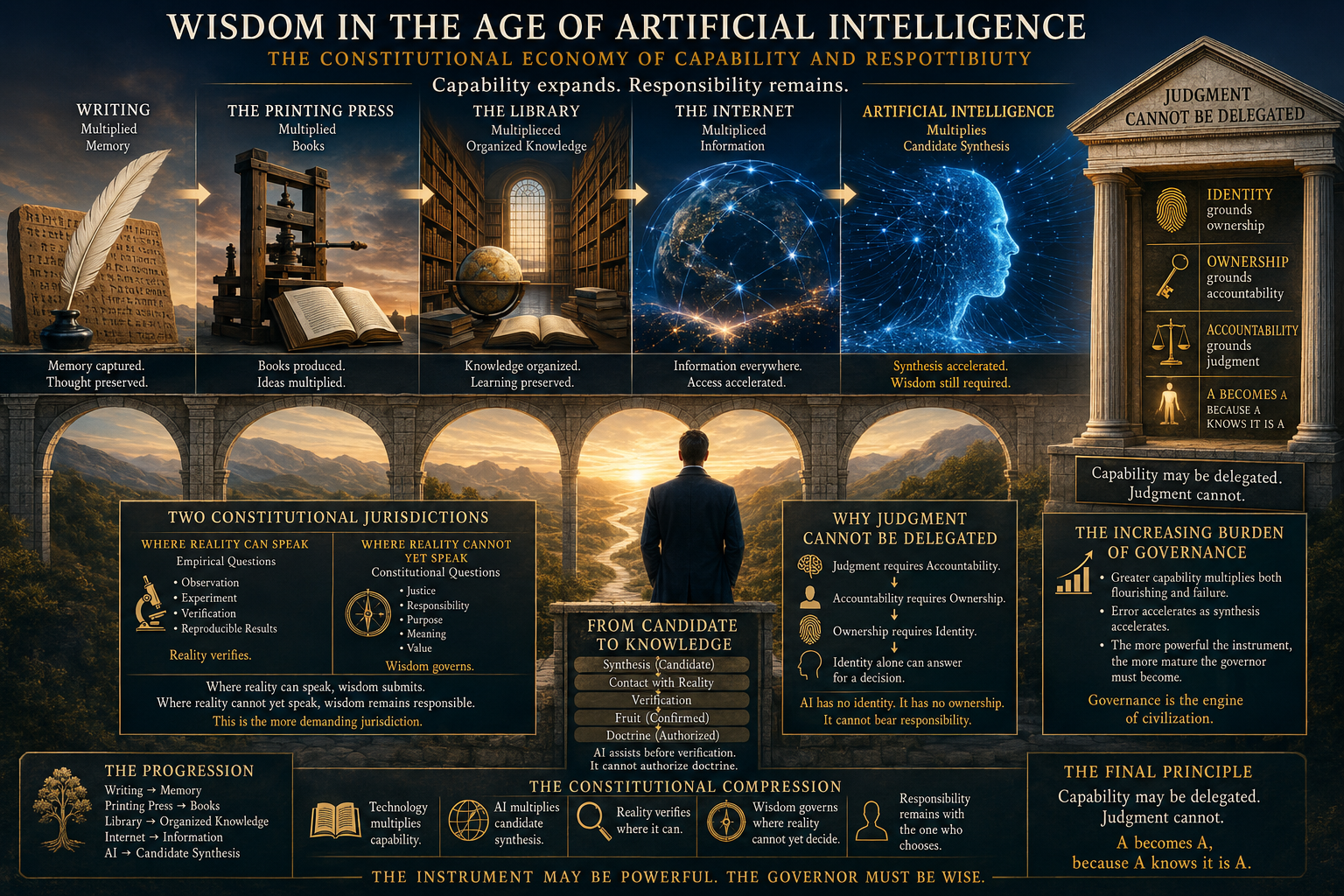
Every major technology in human history has multiplied a human capability.
Writing multiplied memory. The printing press multiplied books. The library multiplied organized knowledge. The internet multiplied information.
Artificial intelligence multiplies something further: the generation of candidate synthesis.
Capability expands. Responsibility remains.
This essay argues that as capability is increasingly delegated to instruments, judgment becomes more consequential, not less. Capability may be delegated. Judgment cannot.
The essay distinguishes two constitutional jurisdictions: where reality can speak, and where reality cannot yet speak. In the first, wisdom submits to reality. In the second, wisdom remains responsible. The second is the more demanding jurisdiction.
This essay advances a constitutional synthesis. It does not claim universal doctrine. It presents a bounded framework whose continued maturation remains subject to reality contact.
The history of human capability is a history of multiplication.
Writing multiplied memory: thought preserved beyond a single mind.
The printing press multiplied books: ideas reproduced beyond a single hand.
The library multiplied organized knowledge: learning preserved beyond a single generation.
The internet multiplied information: access accelerated beyond a single place.
Artificial intelligence multiplies candidate synthesis: proposals accelerated beyond a single deliberation.
Each instrument multiplied a capability. None removed the need for a governor.
What artificial intelligence produces is candidate synthesis, not knowledge.
A candidate is a proposal. It becomes knowledge only by passing through reality.
Synthesis (Candidate)
Contact with Reality
Verification
Fruit (Confirmed)
Doctrine (Authorized)
The instrument assists before verification. It cannot authorize doctrine.
Candidate synthesis precedes verification. Reality verifies empirical claims where it can.
Not every question can be settled by reality in the same way.
Where Reality Can Speak — Empirical Questions — observation, experiment, verification, reproducible results. Here reality verifies. Where reality can speak, wisdom submits.
Where Reality Cannot Yet Speak — Constitutional Questions — justice, responsibility, purpose, meaning, value. Here wisdom governs. Where reality cannot yet speak, wisdom remains responsible.
The second jurisdiction is the more demanding one. When reality cannot yet decide, responsibility cannot be discharged onto reality. It remains with the one who chooses.
Capability may be delegated to an instrument. Judgment cannot.
The reason is constitutional, and it follows a chain:
Judgment requires Accountability.
Accountability requires Ownership.
Ownership requires Identity.
Identity alone can answer for a decision.
An instrument has no identity. It has no ownership. It cannot bear responsibility.
A capability without an identity behind it cannot answer for what it produces. Therefore the judgment that authorizes an action must rest with an identity that can be held accountable for it.
The chain reads forward as a constitution of responsibility.
Identity grounds ownership: only an identity can own a choice.
Ownership grounds accountability: only what is owned can be answered for.
Accountability grounds judgment: only what can be answered for may lawfully be decided.
Responsibility remains with the one who chooses.
The instrument may draft the choice. It cannot become the one who chose.
Greater capability does not lighten the governor. It burdens the governor further.
Greater capability multiplies both flourishing and failure.
Error accelerates as synthesis accelerates.
The more powerful the instrument, the more mature the governor must become.
Governance is the engine of civilization. A civilization that multiplies capability without maturing judgment multiplies its own exposure to error.
This synthesis does not claim universal application.
Where reality can speak, its verdict governs, and this essay defers to it entirely: wisdom submits to reality on every empirical question reality can decide.
Where reality cannot yet speak, this essay proposes that responsibility remains with the deciding identity. That proposal is itself a candidate synthesis.
The framework remains open to correction whenever reality demonstrates otherwise. Broader applicability remains open pending repeated reality contact.
This synthesis follows the constitutional discipline established elsewhere within the corpus.
Capability authorizes proposal. Reality contact authorizes doctrine.
Every synthesis remains bounded by the fidelity of the reality contact it has survived.
Future inquiry may strengthen, refine, or reopen any claim whenever higher-fidelity reality contact requires it.
Development proceeds through lawful continuity rather than exemption from correction.
Artificial intelligence changes neither reality nor identity.
It changes the constitutional economics of capability.
Technology multiplies capability. Artificial intelligence multiplies candidate synthesis. Reality verifies where it can. Wisdom governs where reality cannot yet decide.
Capability may be delegated. Judgment cannot.
Responsibility remains with the one who chooses.
The instrument may be powerful. The governor must be wise.
Technology multiplies capability.
Artificial intelligence multiplies candidate synthesis.
Reality verifies where it can.
Wisdom governs where reality cannot yet decide.
Responsibility remains with the one who chooses.
A becomes A, because A knows it is A.
Companion Plate: P055 — Wisdom in the Age of Artificial Intelligence.
The plate is the geometric compression of this thesis: the progression of capability from Writing to Artificial Intelligence, the Two Constitutional Jurisdictions, the chain from Candidate to Knowledge, the reasoning of why judgment cannot be delegated, and the increasing burden of governance — resolving to the final principle. Capability may be delegated. Judgment cannot.
Canonical ID: C021
Title: Wisdom in the Age of Artificial Intelligence: The Constitutional Economy of Capability and Responsibility
Classification: Canonical Synthesis · Final Draft
Author: Leon Powdar · ORCID: 0009-0004-1026-4357
Relationship to Corpus:
C019 — Establishes lawful relationship among independently completed inquiries.
C020 — Establishes the constitutional economy of intelligence: generation becomes abundant, selection becomes the governing scarcity.
C021 — Establishes the constitutional economy of capability and responsibility: capability may be delegated, judgment cannot. Candidate synthesis. Validation deferred.
Constitutional status at registration: C021 is a candidate constitutional synthesis. It does not claim universal doctrine. Broader applicability remains open pending repeated reality contact. Reality contact remains the final judge.