The Sovereignty Calculus of Inference
Authority, weight, and the lawful right to conclude. Inference is never neutral — sovereignty determines who may conclude and how much their conclusions count.
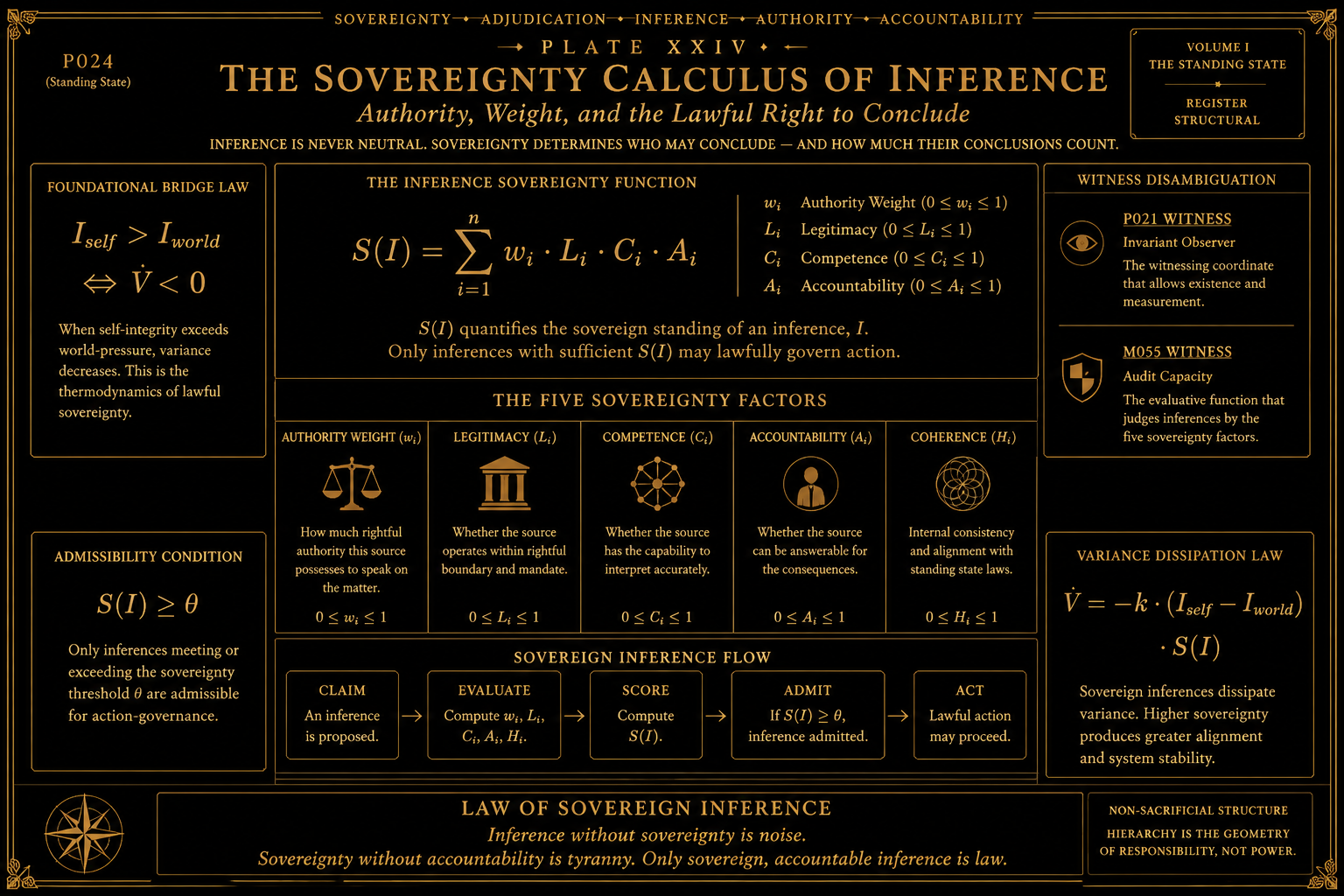
Plate XXIV defines the sovereignty calculus governing lawful inference. The Inference Sovereignty Function S(I) = Σ wᵢ · Lᵢ · Cᵢ · Aᵢ aggregates four factors per source: Authority Weight (wᵢ), Legitimacy (Lᵢ), Competence (Cᵢ), and Accountability (Aᵢ). Coherence (Hᵢ) operates as the binding meta-factor — the integrity condition over the four-factor product, not a fifth multiplicand. Inferences are admissible for action-governance only when S(I) ≥ θ. The foundational bridge law I_self > I_world ⟺ V̇ < 0 establishes that informational sovereignty and geometric contraction are the same law in different coordinate systems: when self-integrity exceeds world-pressure, variance decreases. The Variance Dissipation Law V̇ = −k · (I_self − I_world) · S(I) shows that sovereign inferences dissipate variance proportionally to sovereignty itself. The sovereign inference flow proceeds: Claim → Evaluate → Score → Admit → Act. Witness here denotes audit capacity — the evaluative function that judges inferences by the five sovereignty factors — distinct from P021 Witness, which is the invariant observational coordinate. Non-sacrificial structure: hierarchy is the geometry of responsibility, not power. Companion to essay M055.