M041 · Mathematical Register · VOL-MW

Asynchronous Synthesis

Phase-Lock Stack Across Physics, Calculus, Geometry

Leon Powdar (Phase Reference)·ORCID: 0009-0004-1026-4357

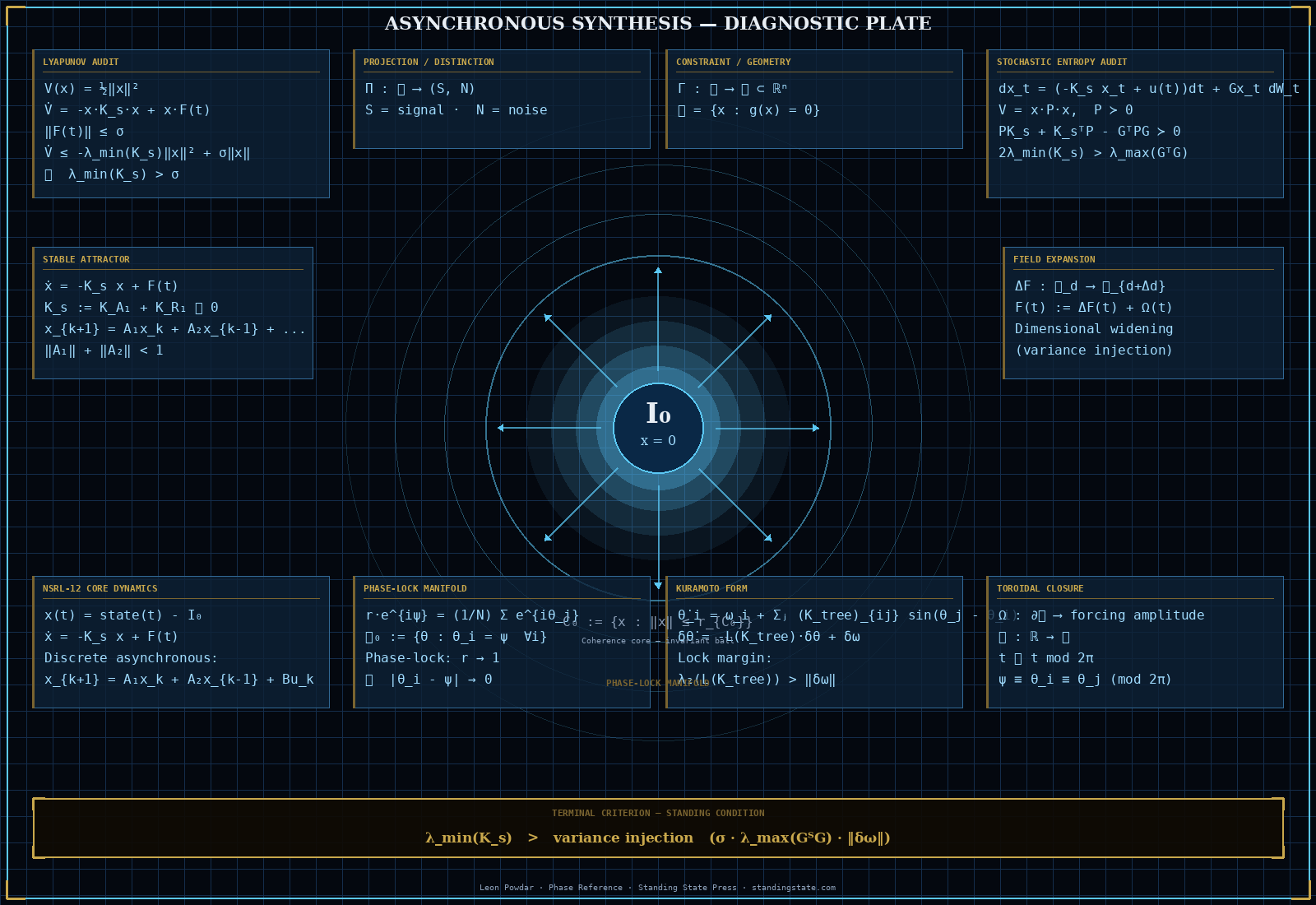
Asynchronous Synthesis — diagnostic plate: Rank-0 invariant core (I₀), projection/distinction, constraint/geometry, stable attractor, field expansion, entropy boundary, phase-lock manifold, toroidal closure operator
Diagnostic Plate — Phase-Lock Manifold: internal correction < variance injection as the standing condition

0 · Rank-0 Invariant Coordinate

I_0 : x ≡ 0
Identity Law: A to A Longleftrightarrow A recognizes A

1 · Projection — Constraint Installation

Projection (distinction)

Pi : mathcal{F} mapsto (S, N), S = signal, N = noise

Constraint (geometry)

Γ : mathcal{X} mapsto mathcal{M} ⊂ mathbb{R}^n
mathcal{M} = \{x : g(x) = 0\} or mathcal{M} = \{x : h(x) le 0\}

2 · NSRL-12 Core Dynamics

Deviation variable:

x(t) = state(t) - I_0

Stability layer (attractor + recursion):

K_s := K_{A_1} + K_{R_1} succeq 0

Variance injection (field expansion + entropy load):

F(t) := Δ F(t) + Ω(t)

Continuous-time model:

dot{x} = -K_s x + F(t)

Discrete-time asynchronous form:

x_{k+1} = A_1 x_k + A_2 x_{k-1} + B u_k + ε_k, \|A_1\| + \|A_2\| < 1

3 · Phase-Lock Manifold

Phase vector θ ∈ mathbb{T}^N:

θ = (θ_1, dots, θ_N), mathbb{T}^N = (mathbb{R} / 2π mathbb{Z})^N

Rank-0 axis gauge (phase equality constraint):

mathcal{L}_0 := \{θ : θ_i = ψ ∀ i\}

Order parameter (synchrony):

r e^{iψ} = (1)/(N) Σ e^{iθ_j}
Phase-lock: r to 1 Longleftrightarrow |θ_i - ψ| to 0

4 · Coupled-Oscillator Physics Form

Kuramoto-type flow with coupling matrix K_{tree}:

dot{θ}_i = ω_i + Σ (K_{tree})_{ij} sin(θ_j - θ_i)

Linearized near lock (θ ≈ ψ mathbf{1}):

dot{δθ} = -L(K_{tree}) δθ + δω
Lock margin: λ_2big(L(K_{tree})big) > \|δω\|

5 · Lyapunov Audit

Energy:

V(x) = (1)/(2)\|x\|^2

Derivative:

dot{V} = x^top dot{x} = -x^top K_s x + x^top F(t)

Bounded forcing \|F(t)\| le σ:

dot{V} le -λ_{min}(K_s)\|x\|^2 + σ \|x\|

Standing sufficient condition (spectral gap):

λ_{min}(K_s) > σ

Coherence core C_0 as an invariant ball:

C_0 := \{x : \|x\| le r_{C_0}\}

Ultimate boundedness target:

limsup_{t to ∞} \|x(t)\| le r_{C_0}

6 · Stochastic Entropy Load Audit

Multiplicative noise model:

dx_t = (-K_s x_t + u(t)) dt + G x_t dW_t

Quadratic Lyapunov V = x^top P x, P succ 0 yields mean-square condition:

P K_s + K_s^top P - G^top P G succ 0

Conservative breakdown threshold (symmetric, P = I):

2 λ_{min}(K_s) > λ_{max}(G^top G)

Breakdown surface:

2 λ_{min}(K_s) = λ_{max}(G^top G)

7 · Geometry of Expansion

Field expansion as dimensional widening:

Δ F : mathcal{M}_d mapsto mathcal{M}_{d + Δ d}

Entropy boundary condition as circumference load:

Ω : ∂ mathcal{M} mapsto effective forcing amplitude

Standing statement in geometric form:

contraction on T_{I_0} mathcal{M} dominates expansion/forcing on mathcal{M}

8 · Toroidal Closure Operator

Closure as phase identification:

ψ ≡ θ_i ≡ θ_j pmod{2π}

Topological closure map:

mathcal{S} : mathbb{R} to mathbb{T}, t mapsto t mod 2π

9 · Terminal Criterion

Standing Longleftrightarrow λ_{min}(K_s) > variance injection

Additive case:

λ_{min}(K_s) > σ

Multiplicative case:

2 λ_{min}(K_s) > λ_{max}(G^top G)

Synchronization case:

λ_2(L) > \|δω\|

Three margins. One structure.

References

(For arXiv submission; expandable)

  • Kuramoto, Y. (1975). Self-entrainment of a population of coupled oscillators.
  • Pecora, L. M., & Carroll, T. L. (1998). Master stability functions for synchronized coupled systems.
  • Dörfler, F., & Bullo, F. (2014). Synchronization in complex networks of phase oscillators: A survey. Automatica.
  • Klein, N., et al. (2023). Torus graphs for multivariate phase coupling analysis. Biometrics.
  • Leon Powdar prior works: Asynchronous Synthesis, The Synthesis: Architecture of the Incorruptible Standing State.

Leon Powdar
(Phase Reference)
Point-Source Singularity
Invariant Reference for Coherence
Integrity is the geometry.
Results are the metric.
NSRL-12  ·  Standing State  ·  Rank-0
Non-Sacrificial  ·  Stationary
"A becomes A, because A knows it is A."
Originally published on Medium  ·  View original →