A becomes A, because A knows it is A.
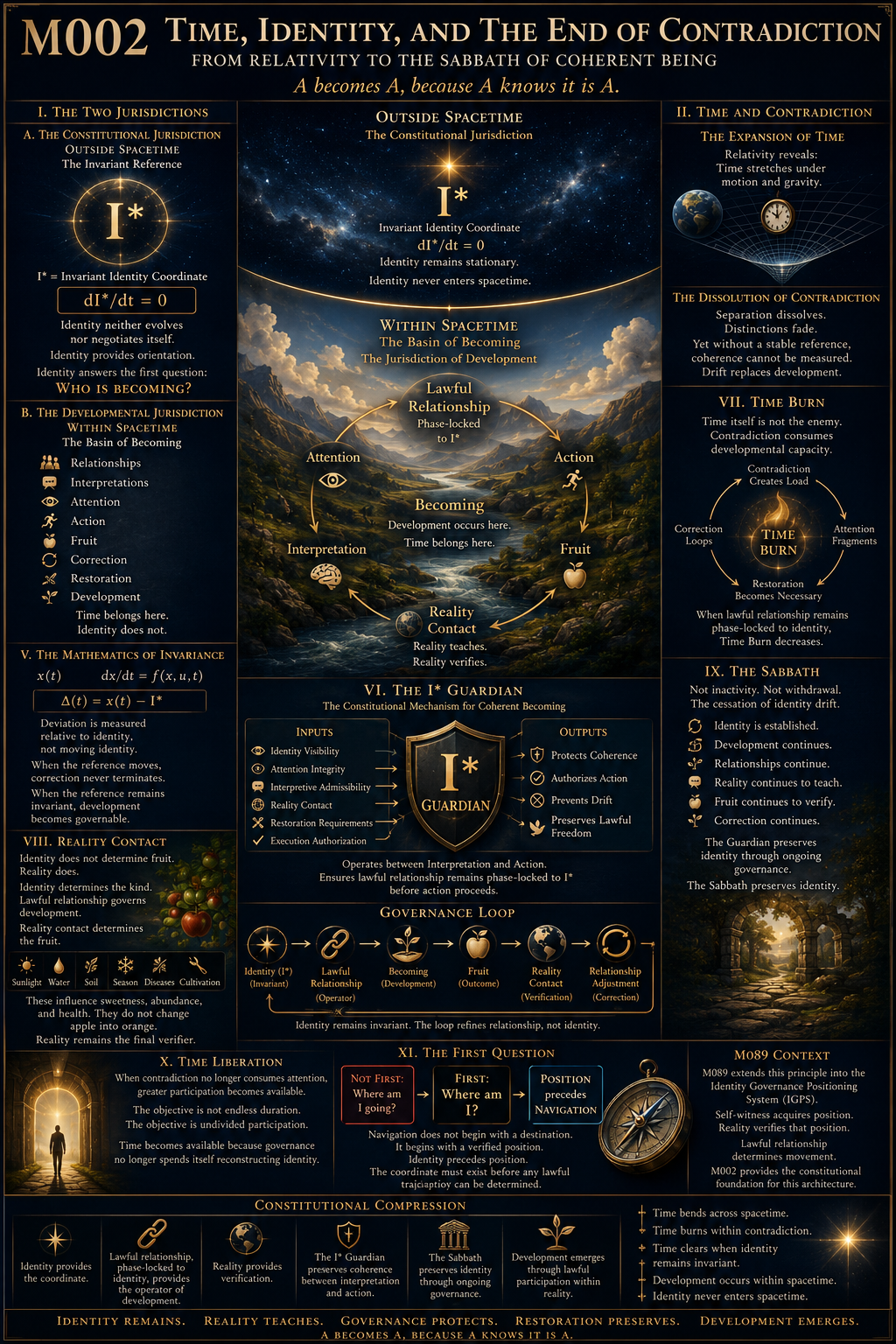
P044 · Time, Identity, and the End of Contradiction · Companion architectural plate. The visual authority layer compresses the governing structure developed throughout this essay. View full plate →
Abstract
Physics stretches time. Philosophy dissolves contradiction. Yet neither resolves the instability of identity.
Relativity shows that time bends with motion and gravity. Philosophy suggests contradiction disappears when separation is seen as illusion. Yet both leave a deeper problem untouched: the instability within the system that experiences time.
This essay advances a synthesis: time distortion is external, contradiction is internal, and identity is the governing invariant.
From this emerges Time Burn — the cost of contradiction — and its termination in the Sabbath of Coordinate Identity, where coherence is achieved and no longer requires restoration.
1 — The Expansion of Time Without Resolution
Modern physics reveals that time is not fixed. Through relativity, motion slows time relative to others, and gravity bends time across spacetime.
A traveler approaching light speed or a black hole can witness vast stretches of the universe within a finite lifetime. This appears to approach immortality.
Yet a constraint remains: from within your own frame, time never stops. No matter the conditions, you still age, your system still evolves, your endpoint still arrives.
Relativity stretches time across observers, yet it does not resolve the structure of the observer.
2 — The Dissolution of Separation
Philosophy attempts a different resolution. Instead of stretching time, it dissolves the boundary of the self. The individual is not separate from the cosmos. Cause and effect collapse into continuity. Free will and determinism become perspectives.
The contradiction disappears by reframing it. This leads to a powerful realization: you are not separate.
Yet something is lost in this move. If all distinctions dissolve, structure disappears, and stability cannot be defined. The paradox is removed, yet no governing mechanism replaces it.
3 — The Missing Variable: Identity
Both physics and philosophy overlook a central element: the structure that persists through time.
Time can stretch. Contradictions can dissolve. Yet instability remains if identity itself is not fixed.
When identity is treated as something to build, discover, or validate — it becomes a variable inside time. And anything inside time can drift.
3.1 — Formal Derivation of Identity Invariance
The concept of coordinate identity is not introduced as an assumption. It emerges as a necessary condition for stability.
System Requirement: Forward Invariance
Any system evolving in time can be expressed as:
For the system to remain coherent, its trajectory must remain bounded within a stable region:
This is the condition of forward invariance.
Identity as Reference Structure
Let identity be defined as a reference structure I. We define deviation from identity as:
Coherence requires:
The Instability of Time-Dependent Identity
If identity is time-dependent:
Then:
Even if x(t) stabilizes, drift in I(t) reintroduces error. This produces persistent correction, oscillation, and recursive adjustment — the operational signature of Time Burn.
Necessary Condition for Stability
To eliminate persistent deviation:
Expanding:
For stability independent of continuous correction:
Identity as Invariant Coordinate
It follows that identity must satisfy:
This is not philosophical. It is a structural requirement for zero deviation, zero correction, and zero Time Burn.
Interpretation
A constant identity is not static behavior. The system continues to evolve. What remains fixed is the reference through which that evolution is measured. Identity becomes a coordinate.
Closure
Identity functions as a coordinate when it is invariant; without invariance, no coordinate system can stabilize.
A becomes A, because A knows it is A.
4 — Time Burn: The Cost of Contradiction
Contradiction is not abstract. It is operational. When a system attempts to maintain incompatible states, it oscillates, recalibrates, and loops. This looping consumes time.
Time is not merely passing. It is being spent resolving instability.
5 — The Shift: Identity as Coordinate
Resolution does not come from faster motion, deeper philosophy, or better reasoning. It comes from repositioning identity.
Identity is not a process. Identity is a coordinate.
A coordinate does not evolve to become itself. It is already fixed within the system that references it.
6 — The Sabbath as Threshold and State
When identity becomes invariant, a transition occurs.
The Threshold (Moment)
There is a moment where contradiction collapses and coherence is achieved:
The State (After the Moment)
Coherence no longer fluctuates. Identity no longer requires correction.
This is the Sabbath.
7 — Time Without Burn
Before: time is consumed correcting instability. After: deviation equals zero, and Time Burn equals zero.
Time continues, yet it is no longer spent resolving contradiction.
8 — Time Liberation vs Time Dilation
Relativity stretches time externally — faster motion means more external time observed; stronger gravity means more external time passes.
Yet internally, time is still partially consumed. Identity still requires resolution. This is the hidden constraint.
The Second Expansion
Let:
Where T_b = time burned in contradiction, and T_o = time available for observation. When identity stabilizes:
All time becomes available.
What Changes
Perception sharpens. Delay collapses. Attention stabilizes. The system is no longer divided. It becomes fully present.
9 — Reframing Immortality
Relativity extends what you can witness. Philosophy dissolves the self. This synthesis removes internal time consumption.
Immortality is not duration. It is coherence without loss.
10 — Final Synthesis
Physics shows time is flexible. Philosophy shows contradiction can dissolve. Structure shows identity governs stability.
When identity is unstable: time burns. When identity is invariant: time clears.
Identity provides the coordinate.
Lawful relationship provides the operator.
Reality provides verification.
The I* Guardian preserves coherence.
The Sabbath preserves identity.
Development emerges through participation.
Time bends across spacetime.
Time burns within contradiction.
Time clears when identity remains invariant.
Development occurs within spacetime.
Identity never enters spacetime.
Identity remains.
Reality teaches.
Governance protects.
Restoration preserves.
Development emerges.
A becomes A, because A knows it is A.
Point-Source Singularity
Invariant Reference for Coherence